CPS 353: Internet Programming
Server Side Scripting with PHP
Simon Miner
Gordon College
Last Modified: 09/11/2013
Selected content adapted from material by Marty Stepp, Jessica Miller, and Victoria Kirst © 2012. Used by permission.
Agenda
- Scripture (Ephesians 3) and Prayer
- Check-in
- Page Layout
- Homework 2
- Server Side Basics and PHP
- Milestone 2
Check-in
- Homework 1
- Milestone 1
Page Layout
Continued from last week's slides (starting at #44)...
Homework 2
5.1: Server-Side Basics
- 5.1: Server-Side Basics
- 5.2: PHP Basic Syntax
- 5.3: Embedded PHP
- 5.4: Advanced PHP Syntax
URLs and web servers
http://server/path/file
- many times when you type a URL in your browser:
- your computer looks up the server's IP address using DNS
- your browser connects to that IP address and requests the given file
- the web server software (e.g. Apache) grabs that file from the server's local file system, and sends back its contents to you
- some URLs actually specify programs that the web server should run, and then send their output back to you as the result:
https://math-cs.gordon.edu/cps353/quote.php
- the above URL tells the server
math-cs.gordon.eduto run the programquote2.phpand send back its output
- the above URL tells the server
Server-Side web programming




- server-side pages are programs written using one of many web programming languages/frameworks
- the web server contains software that allows it to run those programs and send back their output
- each language/framework has its pros and cons
- we introduce server-side programmoing using PHP because of its relatively shallow learning curve
- for your project, you will use Ruby and the Ruby on Rails web framework
What is PHP?
- PHP stands for "PHP Hypertext Preprocessor"
- a server-side scripting language
- used to make web pages dynamic:
- provide different content depending on context
- interface with other services: database, e-mail, etc
- authenticate users
- process form information
- PHP code can be embedded in XHTML code
Lifecycle of a PHP web request
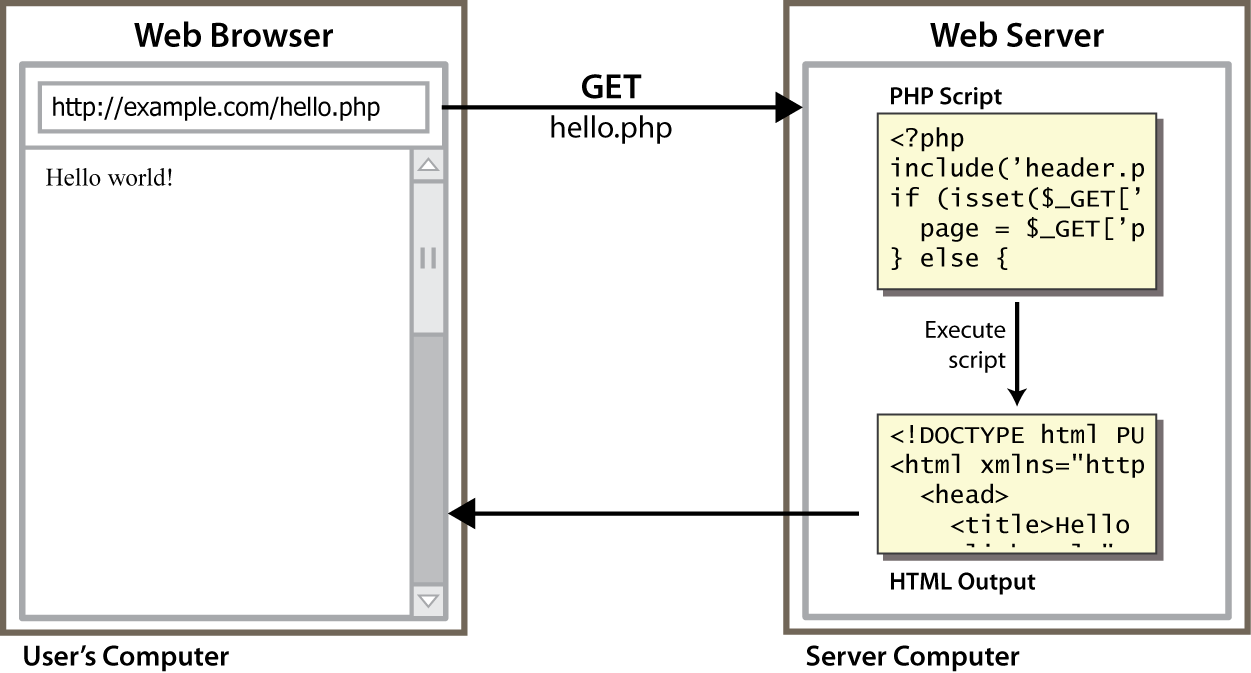
- browser requests a
.htmlfile (static content): server just sends that file - browser requests a
.phpfile (dynamic content): server reads it, runs any script code inside it, then sends result across the network- script produces output that becomes the response sent back
Why PHP?
There are many other options for server-side languages: Ruby on Rails, JSP, ASP.NET, etc. Why choose PHP?
- free and open source: anyone can run a PHP-enabled server free of charge
- compatible: supported by most popular web servers
- simple: lots of built-in functionality; familiar syntax
- available: installed on Gordon's servers (micah) and most commercial web hosts
- well-documented: type
php.net/functionNamein browser Address bar to get docs for any function
Hello, World!
The following contents could go into a file hello.php:
<?php
print "Hello, world!";
?>
Hello, world!
- a block or file of PHP code begins with
<?phpand ends with?> - PHP statements, function declarations, etc. appear between these endpoints
Viewing PHP output
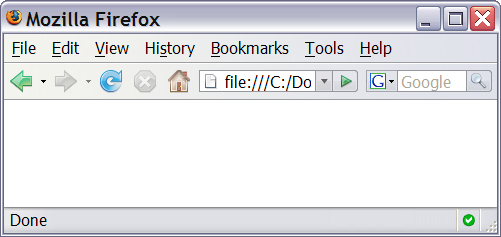
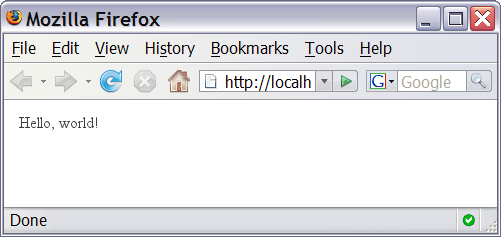
- you can't view your
.phppage on your local hard drive; you'll either see nothing or see the PHP source code - if you upload the file to a PHP-enabled web server, requesting the
.phpfile will run the program and send you back its output
5.2: PHP Basic Syntax
- 5.1: Server-Side Basics
- 5.2: PHP Basic Syntax
- 5.3: Embedded PHP
- 5.4: Advanced PHP Syntax
Console output: print
print "text";
print "Hello, World!\n";
print "Escape \"chars\" are the SAME as in Java!\n";

print "You can have
line breaks in a string.";

print 'A string can use "single-quotes".  It\'s cool!';
Hello, World!
Escape "chars" are the SAME as in Java!
You can have
line breaks in a string.
A string can use "single-quotes". It's cool!
- some PHP programmers use the equivalent
echoinstead ofprint
Arithmetic operators
-
			+ - * / %

			. ++ --

			= += -= *= /= %= .=
- many operators auto-convert types:
5 + "7"is12
Variables
$name = expression;
$user_name = "AnthonyAardvark";
$age = 16;
$drinking_age = $age + 5;
$this_class_rocks = TRUE;
- names are case sensitive
- common idiom is to separate multiple words with _
- names always begin with
$, on both declaration and usage - implicitly declared by assignment (type is not written; a "loosely typed" language)
Types
Comments
# single-line comment

// single-line comment

/*
multi-line comment
*/
- like Java, but
#is also allowed- a lot of PHP code uses
#comments instead of//
- a lot of PHP code uses
for loop
for (initialization; condition; update) {
	statements;
}
for ($i = 0; $i < 10; $i++) {
	print "$i squared is " . $i * $i . ".\n";
}
if/else statement
if (condition) {
	statements;
} elseif (condition) {
	statements;
} else {
	statements;
}
- NOTE: although
elseifkeyword is much more common,else ifis also supported
PHP syntax template
HTML content

	<?php
		PHP code
	?>

HTML content

	<?php
		PHP code
	?>

HTML content ...
- any contents of a
.phpfile between<?phpand?>are executed as PHP code - all other contents are output as pure HTML
- can switch back and forth between HTML and PHP "modes"
Math operations
$a = 3;
$b = 4;
$c = sqrt(pow($a, 2) + pow($b, 2));
abs
|
ceil
|
cos
|
floor
|
log
|
log10
|
max
|
min
|
pow
|
rand
|
round
|
sin
|
sqrt
|
tan
|
M_PI
|
M_E
|
M_LN2
|
- the syntax for method calls, parameters, returns is the same as Java
int and float types
$a = 7 / 2;               # float: 3.5
$b = (int) $a;            # int: 3
$c = round($a);           # float: 4.0
$d = "123";               # string: "123"
$e = (int) $d;            # int: 123
intfor integers andfloatfor reals- division between two
intvalues can produce afloat
String type
$favorite_food = "Ethiopian";
print $favorite_food[2];
- zero-based indexing using square bracket notation
- string concatenation operator is
.(period), not+5 + "2 turtle doves"produces75 . "2 turtle doves"produces"52 turtle doves"
- can be specified with
""or''
Interpolated strings
$age = 16;
print "You are " . $age . " years old.\n";
print "You are $age years old.\n";    # You are 16 years old.
- strings inside
" "are interpolated- variables that appear inside them will have their values inserted into the string
- strings inside
' 'are not interpolated:print 'You are $age years old.\n'; # You are $age years old.\n - if necessary to avoid ambiguity, can enclose variable in
{}:print "Today is your $ageth birthday.\n"; # $ageth not found print "Today is your {$age}th birthday.\n";
String functions
# index  0123456789012345
$name = "Stefanie Hatcher";
$length = strlen($name);              # 16
$cmp = strcmp($name, "Brian Le");     # > 0
$index = strpos($name, "e");          # 2
$first = substr($name, 9, 5);         # "Hatch"
$name = strtoupper($name);            # "STEFANIE HATCHER"
| Name | Java Equivalent |
|---|---|
strlen |
length |
strpos |
indexOf |
substr |
substring |
strtolower, strtoupper |
toLowerCase, toUpperCase |
trim |
trim |
explode, implode |
split, join |
strcmp |
compareTo |
bool (Boolean) type
$feels_like_summer = TRUE;
$php_is_rad = FALSE;

$student_count = 12;
$nonzero = (bool) $student_count;     # TRUE
- the following values are considered to be
FALSE(all others areTRUE):-
0and0.0 -
"","0", andNULL(includes unset variables) - arrays with 0 elements
-
- can cast to boolean using
(bool) FALSEprints as an empty string (no output);TRUEprints as a1
TRUEandFALSEkeywords are case insensitive
5.3: Embedded PHP
- 5.1: Server-Side Basics
- 5.2: PHP Basic Syntax
- 5.3: Embedded PHP
- 5.4: Advanced PHP Syntax
Printing HTML tags in PHP = bad style
<?php
print "<!DOCTYPE html PUBLIC \"-//W3C//DTD XHTML 1.1//EN\"\n";
print " \"http://www.w3.org/TR/xhtml11/DTD/xhtml11.dtd\">\n";
print "<html xmlns=\"http://www.w3.org/1999/xhtml\">\n";
print "  <head>\n";
print "    <title>Geneva's web page</title>\n";
...
for ($i = 1; $i <= 10; $i++) {
	print "<p> I can count to $i! </p>\n";
}
?>
- printing HTML tags with
printstatements is bad style and error-prone:- must quote the HTML and escape special characters, e.g.
\"
- must quote the HTML and escape special characters, e.g.
- but without
print, how do we insert dynamic content into the page?
PHP expression blocks
<?= expression ?>
<h2> The answer is <?= 6 * 7 ?> </h2>
The answer is 42
- PHP expression block: evaluates and embeds an expression's value into HTML
-
<?= expr ?>is equivalent to<?php print expr; ?>
Expression block example
<!DOCTYPE html PUBLIC "-//W3C//DTD XHTML 1.1//EN"
 "http://www.w3.org/TR/xhtml11/DTD/xhtml11.dtd">
<html xmlns="http://www.w3.org/1999/xhtml">
	<head><title>CSE 190 M: Embedded PHP</title></head>
	<body>
		<?php for ($i = 99; $i >= 1; $i--) { ?>
			<p> <?= $i ?> bottles of beer on the wall, <br />
				  <?= $i ?> bottles of beer. <br />
				  Take one down, pass it around, <br />
				  <?= $i - 1 ?> bottles of beer on the wall. </p>
		<?php } ?>
	</body>
</html>
Common errors: unclosed braces, missing = sign
	<body>
		<p>Watch how high I can count:
			<?php for ($i = 1; $i <= 10; $i++) { ?>
				<? $i ?>
		</p>
	</body>
</html>
</body>and</html>above are inside theforloop, which is never closed- if you forget to close your braces, you'll see an error about 'unexpected
$end' - if you forget
=in<?=, the expression does not produce any output
Complex expression blocks
	<body>
		<?php for ($i = 1; $i <= 3; $i++) { ?>
			<h<?= $i ?>>This is a level <?= $i ?> heading.</h<?= $i ?>>
		<?php } ?>
	</body>
This is a level 1 heading.
This is a level 2 heading.
This is a level 3 heading.
- expression blocks can even go inside HTML tags and attributes
5.4: Advanced PHP Syntax
- 5.1: Server-Side Basics
- 5.2: PHP Basic Syntax
- 5.3: Embedded PHP
- 5.4: Advanced PHP Syntax
- 6.1: Parameterized Pages
NULL
$name = "Aardvark";
$name = NULL;
if (isset($name)) {
	print "This line isn't going to be reached.\n";
}
Arrays
$name = array();                         # create
$name = array(value0, value1, ..., valueN);

$name[index]                              # get element value
$name[index] = value;                      # set element value
$name[] = value;                          # append
$a = array();     # empty array (length 0)
$a[0] = 23;       # stores 23 at index 0 (length 1)
$a2 = array("some", "strings", "in", "an", "array");
$a2[] = "Ooh!";   # add string to end (at index 5)
- to append, use bracket notation without specifying an index
- element type is not specified; can mix types
Array functions
| function name(s) | description |
|---|---|
count
|
number of elements in the array |
print_r
|
print array's contents |
array_pop,
array_push, array_shift,
array_unshift
|
using array as a stack/queue |
in_array,
array_search,
array_reverse, sort,
rsort,
shuffle
|
searching and reordering |
array_fill,
array_merge,
array_intersect, array_diff,
array_slice,
range
|
creating, filling, filtering |
array_sum,
array_product,
array_unique, array_filter,
array_reduce
|
processing elements |
Array function example
$tas = array("MD", "BH", "KK", "HM", "JP");
for ($i = 0; $i < count($tas); $i++) {
	$tas[$i] = strtolower($tas[$i]);
}                                 # ("md", "bh", "kk", "hm", "jp")
$morgan = array_shift($tas);      # ("bh", "kk", "hm", "jp")
array_pop($tas);                  # ("bh", "kk", "hm")
array_push($tas, "ms");           # ("bh", "kk", "hm", "ms")
array_reverse($tas);              # ("ms", "hm", "kk", "bh")
sort($tas);                       # ("bh", "hm", "kk", "ms")
$best = array_slice($tas, 1, 2);  # ("hm", "kk")
-
the array in PHP replaces many other collections in Java
- list, stack, queue, set, map, ...
The foreach loop
foreach ($array as $variableName) {
	...
}
$stooges = array("Larry", "Moe", "Curly", "Shemp");
for ($i = 0; $i < count($stooges); $i++) {
	print "Moe slaps {$stooges[$i]}\n";
}
foreach ($stooges as $stooge) {
	print "Moe slaps $stooge\n";  # even himself!
}
- a convenient way to loop over each element of an array without indexes
Splitting/joining strings
$array = explode(delimiter, string);
$string = implode(delimiter, array);
$s  = "CPS 353 FA 2013";
$a  = explode(" ", $s);     # ("CSP", "353", "FA", "2013")
$s2 = implode("...", $a);   # "CSP...353...FA...2013"
explodeandimplodeconvert between strings and arrays- for more complex string splitting, you can use regular expressions
Example with explode
contents of input file
names.txtAnthony Aardvark Frederick Fox Zelda Zebra
foreach (file("names.txt") as $name) {
$tokens = explode(" ", $name);
?>
<p> overused example animal: <?= $tokens[1] ?>, <?= $tokens[0] ?> </p>
<?php
}
overused example animal: Aardvark, Anthony
overused example animal: Fox, Frederick
overused example animal: Zebra, Zelda
Functions
function name(parameterName, ..., parameterName) {
	statements;
}
function bmi($weight, $height) {
	$result = 703 * $weight / $height / $height;
	return $result;
}
- parameter types and return types are not written
- a function with no
returnstatements is implicitly "void" - can be declared in any PHP block, at start/end/middle of code
Calling functions
name(expression, ..., expression);
$w = 163;  # pounds
$h = 70;   # inches
$my_bmi = bmi($w, $h);
- if the wrong number of parameters are passed, it's an error
Variable scope: global and local vars
$school = "Gordon";                   # global
...

function downgrade() {
	global $school;
	$suffix = "(College)";        # local

	$school = "$school $suffix";
	print "$school\n";
}
- variables declared in a function are local to that function; others are global
- if a function wants to use a global variable, it must have a
globalstatement- but don't abuse this; mostly you should use parameters
Default parameter values
function name(parameterName = value, ..., parameterName = value) {
	statements;
}
function print_separated($str, $separator = ", ") {
	if (strlen($str) > 0) {
		print $str[0];
		for ($i = 1; $i < strlen($str); $i++) {
			print $separator . $str[$i];
		}
	}
}
print_separated("hello");        # h, e, l, l, o
print_separated("hello", "-");   # h-e-l-l-o
- if no value is passed, the default will be used (defaults must come last)
5.4: PHP File Input
- 5.1: Server-Side Basics
- 5.2: PHP Basic Syntax
- 5.3: Embedded PHP
- 5.4: Advanced PHP Syntax
PHP file I/O functions
| function name(s) | category |
|---|---|
file,
file_get_contents, file_put_contents
|
reading/writing entire files |
basename,
file_exists,
filesize, fileperms,
filemtime,
is_dir, is_readable,
is_writable,
disk_free_space
|
asking for information |
copy,
rename,
unlink,
chmod, chgrp,
chown,
mkdir,
rmdir
|
manipulating files and directories |
glob,
scandir
|
reading directories |
Reading/writing files
contents of foo.txt |
file("foo.txt") |
file_get_contents("foo.txt") |
|---|---|---|
Hello how r u? I'm fine |
array( "Hello\n", # 0 "how r u?\n", # 1 "\n", # 2 "I'm fine\n" # 3 ) |
"Hello\n how r u?\n # a single \n # string I'm fine\n" |
filefunction returns lines of a file as an array (\nat end of each)file_get_contentsreturns entire contents of a file as a single string-
file_put_contentswrites a string into a file
-
Reading/writing an entire file
# reverse a file
$text = file_get_contents("poem.txt");
$text = strrev($text);
file_put_contents("poem.txt", $text);
file_get_contentsreturns entire contents of a file as a string- if the file doesn't exist, you will get a warning and an empty return string
file_put_contentswrites a string into a file, replacing its old contents- if the file doesn't exist, it will be created
Appending to a file
# add a line to a file
$new_text = "P.S. ILY, GTG TTYL!~";
file_put_contents("poem.txt", $new_text, FILE_APPEND);
| old contents | new contents |
|---|---|
Roses are red, Violets are blue. All my base, Are belong to you. |
Roses are red, Violets are blue. All my base, Are belong to you. P.S. ILY, GTG TTYL!~ |
file_put_contentscan be called with an optional third parameter to append (add to the end) rather than overwrite
The file function
# display lines of file as a bulleted list
$lines = file("todolist.txt");
foreach ($lines as $line) {        # for ($i = 0; $i < count($lines); $i++)
	print "<li>$line</li>\n";
}
filereturns the lines of a file as an array of strings-
each ends with
\n; to strip it, use an optional second parameter:$lines = file("todolist.txt", FILE_IGNORE_NEW_LINES); - common idiom:
foreachorforloop over lines of file
Unpacking an array: list
list($var1, ..., $varN) = array;
contents of input file
personal.txtAnthony Aardvark (978) 555-1212 978-555-3434
list($name, $phone, $ssn) = file("personal.txt");
...
-
the odd
listfunction "unpacks" an array into a set of variables you declare -
when you know a file's exact length/format, use
fileandlistto unpack it
Reading directories
| function | description |
|---|---|
scandir |
returns an array of all file names in a given directory (returns just the file names, such as "myfile.txt")
|
glob |
returns an array of all file names that match a given pattern (returns a file path and name, such as "foo/bar/myfile.txt")
|
-
globcan accept a general path with the*wildcard character
glob example
# reverse all poems in the poetry directory
$poems = glob("poetry/poem*.dat");
foreach ($poems as $poemfile) {
	$text = file_get_contents($poemfile);
	file_put_contents($poemfile, strrev($text));
	print "<p>I just reversed " . basename($poemfile) . "</p>\n";
}
-
globcan match a "wildcard" path with the*character-
glob("foo/bar/*.doc")returns all.docfiles in thefoo/barsubdirectory -
glob("food*")returns all files whose names begin with "food"
-
-
the
basenamefunction strips any leading directory from a file path-
basename("foo/bar/baz.txt")returns"baz.txt"
-
scandir example
<ul>
	<?php
	$folder = "taxes/old";
	foreach (scandir($folder) as $filename) {
		print "<li>$filename</li>\n"
	}
	?>
</ul>
- .
- ..
- 2007_w2.pdf
- 2006_1099.doc
scandirincludes current directory (".") and parent ("..") in the array-
don't need
basenamewithscandir; returns file names only without directory
Why use classes and objects?
- PHP is a primarily procedural language
- small programs are easily written without adding any classes or objects
- larger programs, however, become cluttered with so many disorganized functions
- grouping related data and behavior into objects helps manage size and complexity
Constructing and using objects
# construct an object
$name = new ClassName(parameters);

# access an object's field (if the field is public)
$name->fieldName

# call an object's method
$name->methodName(parameters);
$zip = new ZipArchive();
$zip->open("moviefiles.zip");
$zip->extractTo("images/");
$zip->close();
- the above code unzips a file
- test whether a class is installed with
class_exists
Object example: Fetch file from web
# create an HTTP request to fetch student.php
$req = new HttpRequest("student.php", HttpRequest::METH_GET);
$params = array("first_name" => $fname, "last_name" => $lname);
$req->addPostFields($params);

# send request and examine result
$req->send();
$http_result_code = $req->getResponseCode();   # 200 means OK
print "$http_result_code\n";
print $req->getResponseBody();
- PHP's
HttpRequestobject can fetch a document from the web
Class declaration syntax
class ClassName {
	# fields - data inside each object
	public $name;    # public field
	private $name;   # private field

	# constructor - initializes each object's state
	public function __construct(parameters) {
		statement(s);
	}

	# method - behavior of each object
	public function name(parameters) {
		statements;
	}
}
- inside a constructor or method, refer to the current object as
$this
Class example
<?php
class Point {
	public $x;
	public $y;

	# equivalent of a Java constructor
	public function __construct($x, $y) {
		$this->x = $x;
		$this->y = $y;
	}

	public function distance($p) {
		$dx = $this->x - $p->x;
		$dy = $this->y - $p->y;
		return sqrt($dx * $dx + $dy * $dy);
	}

	# equivalent of Java's toString method
	public function __toString() {
		return "(" . $this->x . ", " . $this->y . ")";
	}
}
?>
Class usage example
<?php
# this code could go into a file named use_point.php
include("Point.php");

$p1 = new Point(0, 0);
$p2 = new Point(4, 3);
print "Distance between $p1 and $p2 is " . $p1->distance($p2) . "\n\n";

var_dump($p2);   # var_dump prints detailed state of an object
?>
Distance between (0, 0) and (4, 3) is 5

object(Point)[2]
  public 'x' => int 4
  public 'y' => int 3
-
$p1and$p2are references toPointobjects
Basic inheritance
class ClassName extends ClassName {
	...
}
class Point3D extends Point {
	public $z;

	public function __construct($x, $y, $z) {
		parent::__construct($x, $y);
		$this->z = $z;
	}

	...
}
- the given class will inherit all data and behavior from ClassName
Static methods, fields, and constants
static $name = value;    # declaring a static field
const $name = value;     # declaring a static constant
# declaring a static method
public static function name(parameters) {
	statements;
}
ClassName::methodName(parameters);  # calling a static method (outside class)
self::methodName(parameters);       # calling a static method (within class)
- static fields/methods are shared throughout a class rather than replicated in every object
Abstract classes and interfaces
interface InterfaceName {
	public function name(parameters);
	public function name(parameters);
	...
}

class ClassName implements InterfaceName { ...
abstract class ClassName {
	abstract public function name(parameters);
	...
}
-
interfaces are supertypes that specify method headers without implementations
- cannot be instantiated; cannot contain function bodies or fields
- enables polymorphism between subtypes without sharing implementation code
-
abstract classes are like interfaces, but you can specify fields, constructors, methods
- also cannot be instantiated; enables polymorphism with sharing of implementation code